Optimize Cheap, Deploy Strong: A Recipe for Cost-Efficient GEPA
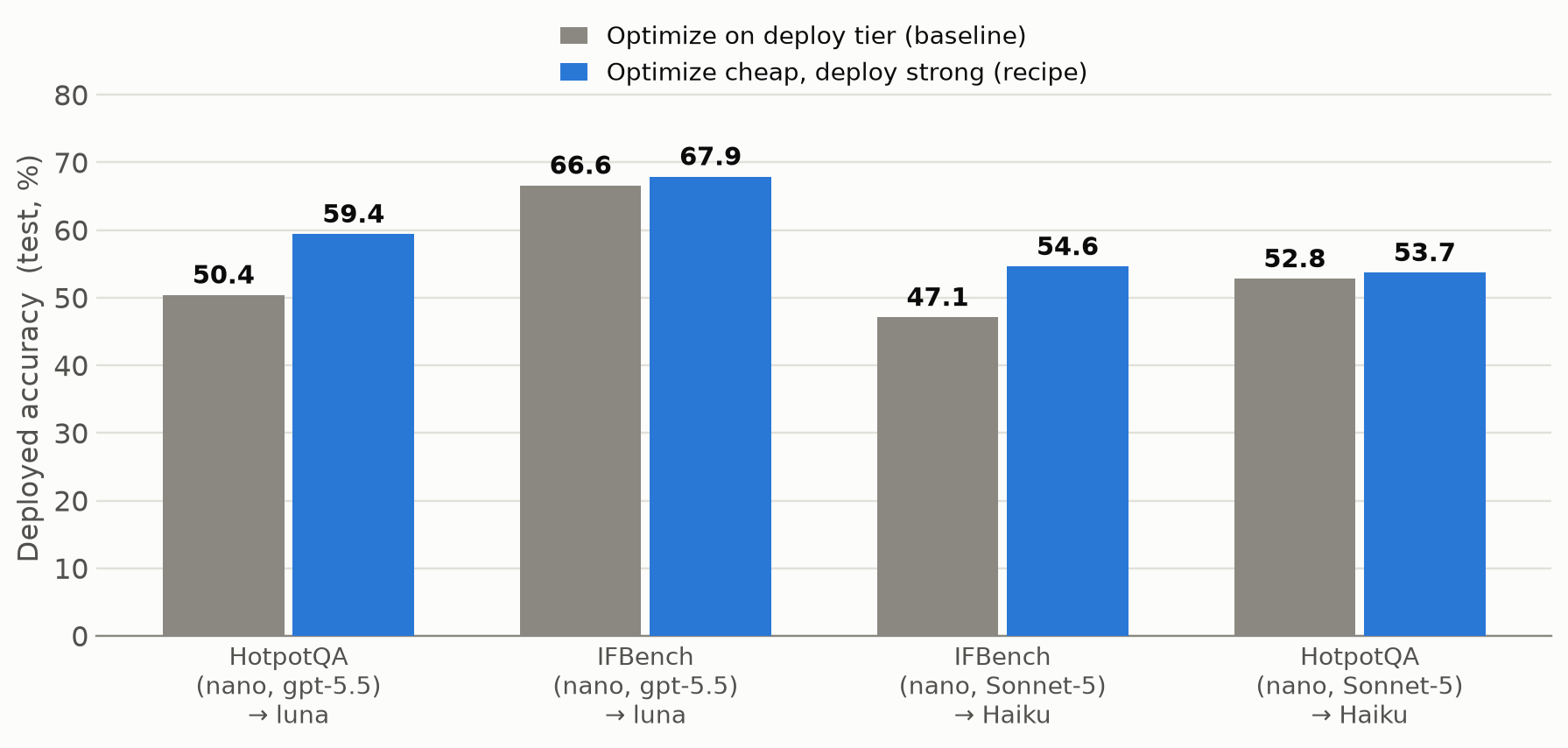
Today, we are sharing a simple recipe for running GEPA at a fraction of the cost, without giving up accuracy. In fact, you often get more of it. On HotpotQA, a prompt optimized this way deploys at 59.4% against 50.4% without using our recipe. That is a +9.0 point gain while spending about 14x less ($7 vs $102). On IFBench the same recipe wins by +7.5 points at about 7x less.
First, the primary cost driver in GEPA is the evaluation phase. GEPA evaluates each candidate prompt on the full validation set every iteration. For every candidate, a task LLM runs the prompt across all of those examples, so over a full optimization run the task LLM is called hundreds or thousands of times. That is what dominates the budget. It raises a simple question: what happens if we run all of those repeated task LLM calls on a very cheap model?
The surprising part is the direction. The cheaper route is also the better one. We call this positive transfer: a prompt tuned with a cheap task LLM can carry upward to a stronger model at deployment, and reach higher accuracy than that strong model reaches when it optimizes for itself.
The Recipe
GEPA optimizes a prompt by running it, scoring the result, and asking a model to reflect on the trace and propose an edit. That loop uses a model in three different roles. The recipe is to stop paying for all three at the same tier, and instead match each role to the cheapest model that can do its job.
-
Answer on the cheapest model. The task LLM runs on every rollout, so it dominates the budget. GEPA calls it hundreds of times per optimization; the reflector is called rarely. Put the task LLM on the cheapest tier you have (we use
gpt-4.1-nano). This single move is most of the saving. -
Reflect with a strong model. The reflection step proposes the edits that actually improve the prompt. It is rare, so it is cheap to make it strong. We call this the asymmetry of intelligence: a strong model (
Sonnet-5,gpt-5.5) writes a precise, well-reasoned edit, and a cheap model only needs to rank whether that edit helped. -
Deploy the evolved prompt on a stronger model, zero-shot. The prompt was learned using a cheap model, but you serve it on the tier you actually ship (
Haiku,luna). No re-optimization. The prompt transfers up.
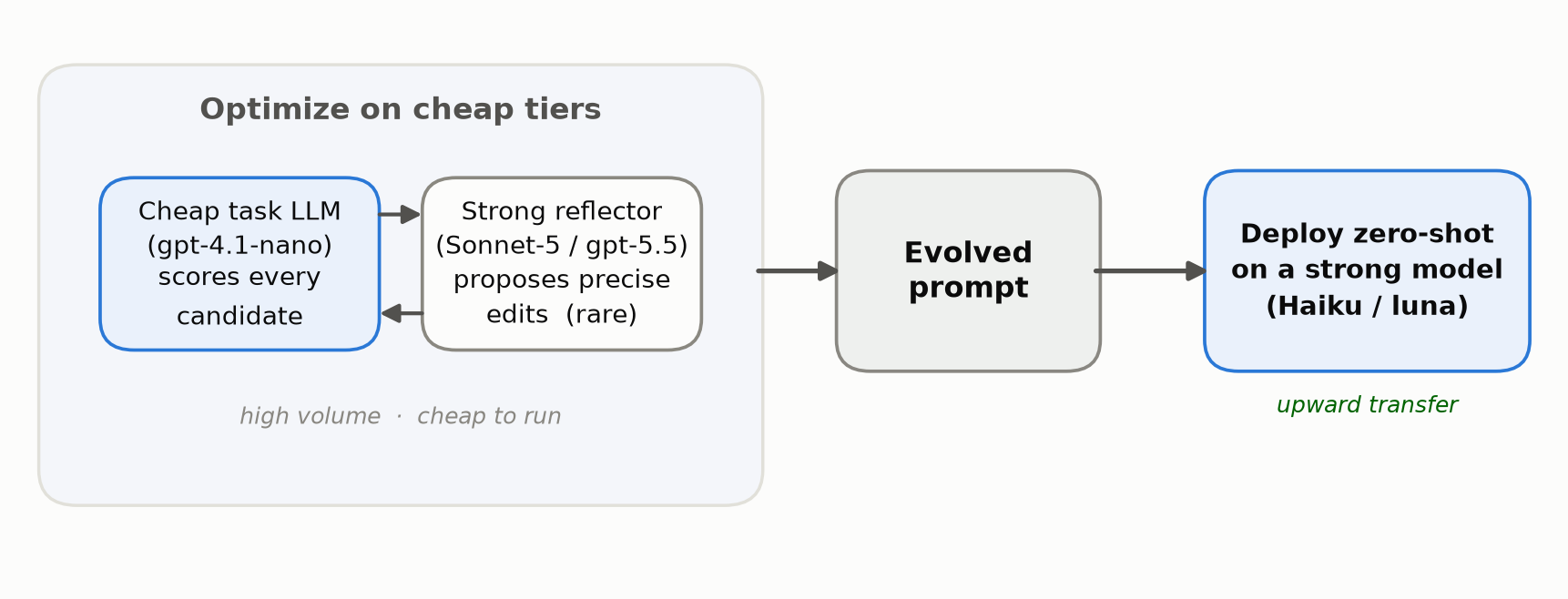
In short: optimize where rollouts are cheap, reflect where reasoning is worth paying for, and deploy where quality matters.
Experiments
We ran the recipe across four tasks, four model families, and eleven models in total. Here is a representative slice, chosen to show the recipe rather than the full sweep.
Start on a cheap model
We run GEPA with gpt-4.1-nano as the task LLM and a strong model as the
reflector, on HotpotQA (multi-hop QA) and IFBench (instruction following). Every
candidate prompt is scored by the cheap task LLM. The strong reflector only sees
the hard cases and proposes the next edit.
The evolved prompt is then deployed, unchanged, on a stronger model. We compare against the honest baseline: running the full GEPA loop directly on that same strong deployment model, task LLM and all.
Transfer to a strong model
This is where the recipe pays off. Deploying the prompt evolved with the cheap task LLM on the strong tier does not just save money. It reaches a higher accuracy than the strong tier reaches when it optimizes for itself.
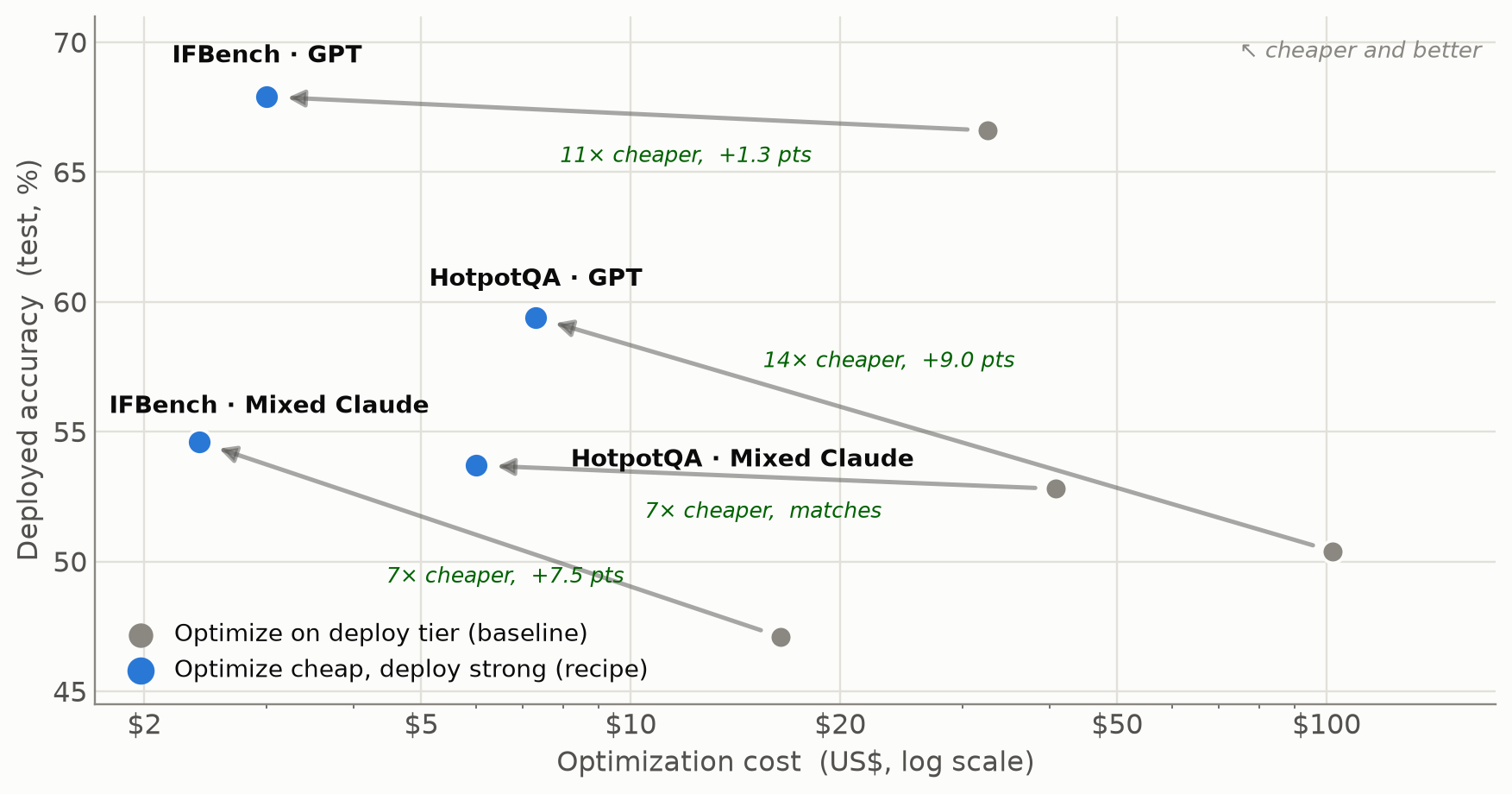
Even the base case is a win. On HotpotQA with the Claude family, the recipe only ties the all-strong baseline on accuracy. But it gets there at about 7x less cost. When transfer helps, you pay less and score higher. When it does not, you still pay a lot less.
Which pairings transfer best
A natural question follows this recipe. If the task LLM, the reflector, and the deployment model can all be different, does it matter whether they come from the same vendor?
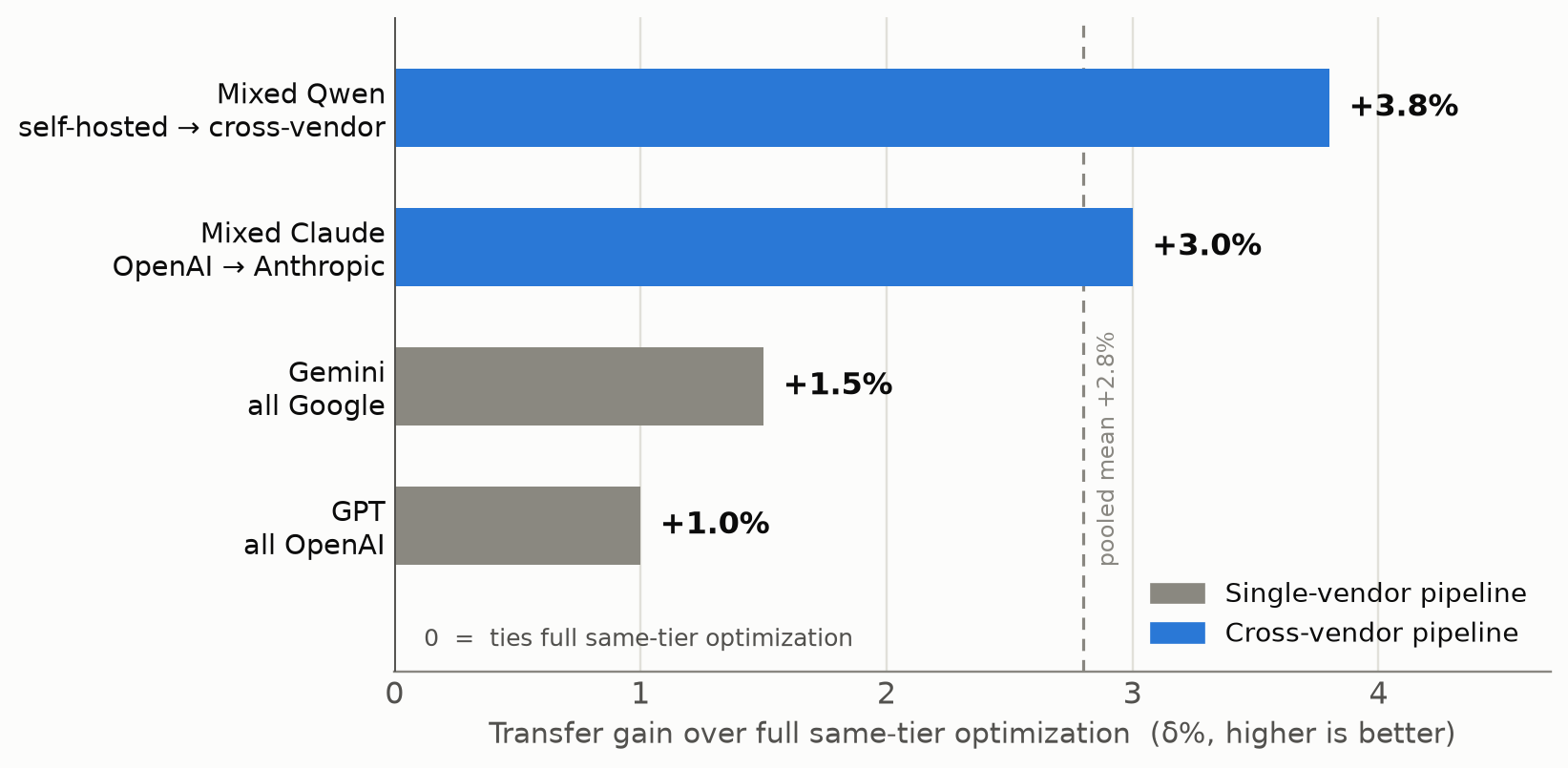
It does, but not in the way vendor loyalty would suggest. What matters is the size of the capability gap between the cheap task LLM and the deployment model, not whether they share a vendor. The largest transfer comes from the pipelines that cross vendors the most, because those are the ones that pair the cheapest possible task LLM with a much stronger deployment model.
Two practical rules come out of this. First, the reflector's vendor does not
matter, only its strength. A cross-vendor reflector (Sonnet-5 proposing edits
for a GPT pipeline) matches or beats a same-vendor one on every task we tried.
Second, the deployment model can cross vendors freely. The biggest gains,
+3.8% pooled, come from the Qwen pipeline, where a self-hosted task LLM feeds
a cross-vendor deployment and the capability gap is widest. Every family
sits at or above the expensive same-tier baseline. Pooled across all setups the gain
is +2.8% (95% CI [+1.3, +4.4]), positive in 36 of 48 setups. At n=3 per
family the bars overlap, so read the ordering as a trend, not a ranking.
Why it works
The cheap task LLM does not need to solve the task. It only needs to rank candidates well enough that the strong reflector's good edits survive to the next generation. Ranking is easier than solving, so a cheap model is enough for it.
The prompts GEPA evolves are also more explicit. They spell out the steps, the format, and the failure cases the reflector saw. We looked at the prompts themselves. The cheap search writes a longer prompt (1.29x), and even per 1,000 tokens it uses more directives (1.26x), more prohibitions (1.17x), and far more capitalized emphasis (2.80x). A stronger deployment model has more capacity to follow that structure, so it exploits the evolved prompt more fully than the small model that helped write it. The prompt is a plan, and a stronger model executes the plan better.
Conclusion
The takeaways:
-
Positive transfer is real. A prompt optimized on a cheap model can beat a prompt optimized directly on the deployment model. The cheaper route is not a compromise. It is often the better result.
-
The task LLM is the budget. It runs on every rollout, so moving it to the cheapest tier is where the 7x to 14x saving comes from. Spend on the reflector instead, because it is rare and it is what drives the gains.
-
Reduce cost, not just improve accuracy. Even when transfer only ties the expensive baseline, the recipe still cuts optimization cost by about 7x. You are never worse off for trying it.
Future directions
-
When it does not help. On prompt-insensitive tasks like LiveBench-Math, there is little to learn from a prompt, so the cheap route only matches the strong one. It does not beat it. Knowing the low-headroom cases up front is part of the recipe.
-
Automatic tier selection. Given a budget, pick the task LLM, the reflector, and the deployment tier automatically. The recipe is a manual version of a choice that should be made for you.